
From Nakhwah to Swaplyst
This is the first issue of The Exchange, the Swaplyst blog. We'll use this space to write about skill exchange, the people behind the swaps, and the idea that holds it all together: we all have something to offer. It felt right to start with where Swaplyst came from. This one comes from our founder, Kamel Al Asmar.
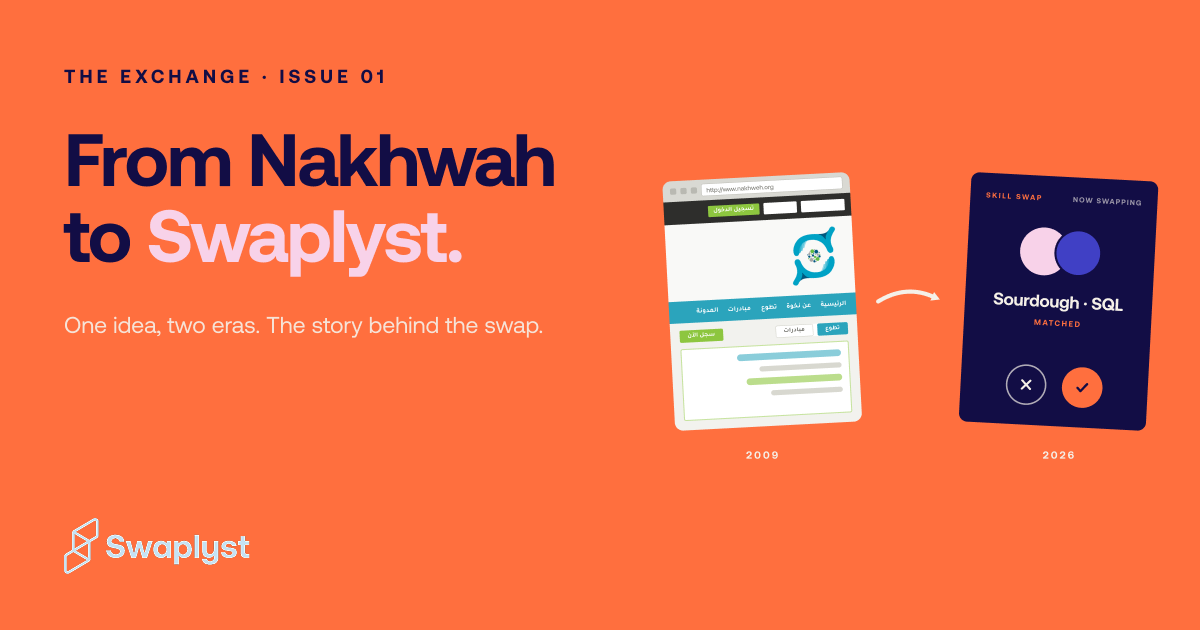
In 2009, I launched a website called Nakhwah. The name comes from an Arabic word that doesn't translate cleanly; the closest meaning is chivalry, the kind where you step up for someone because it's the right thing to do, without being asked and without expecting anything in return.
The idea behind it was simple. People across the region wanted to volunteer but didn't know where to start, and organizations needed help but had no way to reach them. Nakhwah matched the two. It became the first volunteer-matching platform in the Arab world.
I was 25. I built it myself, every line of code. No tech team, no funding round; just a problem I couldn't stop thinking about and enough Ruby on Rails to do something about it.
Nakhwah ran for more than 8 years and served 17 Arab countries. Thousands of volunteers found their way to causes through it, and hundreds of organizations found the hands they needed. It brought recognition I never expected when I started: Forbes, Takreem, an award from King Abdullah II, a fellowship with Ashoka. It also introduced me to a word I hadn't used before: entrepreneurship.
But the metric I keep coming back to has nothing to do with awards. It's the number of people who showed up for each other because a website made it easy to.
The hardest decision
In 2018, I shut Nakhwah down. Nakhwah never made money; that was by design, but it also meant the platform ran on whatever resources I could put into it, and after nearly a decade, those resources ran out. Add a set of personal challenges I was going through at the time, and the decision made itself. Sometimes life asks you to put something down, even something you love, and the honest move is to do it properly rather than let it fade.
I didn't leave the ecosystem, though. If anything, I went deeper into it. Over the years that followed, I worked on community, data, and programs at Wamda, Hub71, DisruptAD, and twofour54; roles that put me alongside hundreds of founders and the people trying to support them.
And everywhere I looked, I kept seeing the same pattern. People with real skills and nowhere to put them to work. Others desperate to learn things that sat behind a paywall or a job title. Startups full of learning opportunities but with no budget to bring people in. The supply and the demand were both there; the bridge wasn't.
That was the Nakhwah problem all over again, just bigger than volunteering.
The idea comes back
The world changed too. The pandemic pushed people to rethink how they spend their time. Layoffs and economic pressure made growth feel urgent, while the cost of learning kept climbing. More people than ever wanted to develop a skill, contribute to something, or gain real experience, and fewer could afford the traditional routes to any of it.
What they had instead was each other. Everyone holds something valuable: a language, a craft, a few hours, years of experience in a field someone else is trying to break into. What was missing was a place to trade it.
So I went back to the idea I never really put down. In 2024, I founded Communitech Labs in Abu Dhabi, and we started building its first product. In September 2024 we launched a quiet alpha, opened up to organizations the following spring, and in November 2025 I stood at Web Summit in Lisbon and announced it publicly: Swaplyst.
What Swaplyst is
Swaplyst is Nakhwah, reimagined for how people give and grow today. You tell us what you can offer and what you want to learn, then you swipe right to connect. From there, exchanges happen in three ways: you swap skills with a peer, you volunteer with an organization, or you intern with a startup. No money changes hands; the exchange is the point.
Nakhwah asked people to give their time. Swaplyst asks a broader question: what do you know, and what do you want to learn? Mentor someone. Pick up a skill you've been putting off. Show up for a cause that matters to you. It's the same spirit that powered Nakhwah, with a wider door.
Nakhwah made giving accessible across the Arab world. Swaplyst is here to take that spirit global.
Why "The Exchange"
We named this blog The Exchange because that's what everything above has always been about. Not transactions, exchanges; the kind where both sides walk away with more than they brought.
In the coming issues, we'll dig into how skill exchange works in practice, what startups and organizations can do with it, and the stories of people already swapping on the platform.
Swaplyst is live on the App Store and Google Play. Got skills? Swap them.
We all have something to offer.
Kamel Al Asmar Founder, Swaplyst