
Nobody applies here
We opened Swaplyst to organizations this week. Here is why nobody applies, and what an organization offers in return for a volunteer's time.
There is a well-worn way for an organization to find volunteers and interns. You write a description, post it somewhere and wait for the applications to arrive. Then you read them, or more honestly, you read the first thirty and skim the rest. The people who wanted the role most are somewhere in that pile. So are the people who applied to forty roles that morning. From the outside they look the same.
But the problem was never a shortage of people who want to help. It was that the wanting and the needing never met in the same place, at the same time, with a way to tell each other apart. I saw it at Nakhwah for nine years. I have seen it in every startup program I have worked in since. Organizations have real opportunities. Volunteers and interns usually only reach the ones inside their own network.
This week we opened Swaplyst to organizations. This issue is about what that means and why we built the matching the way we did.
What opened
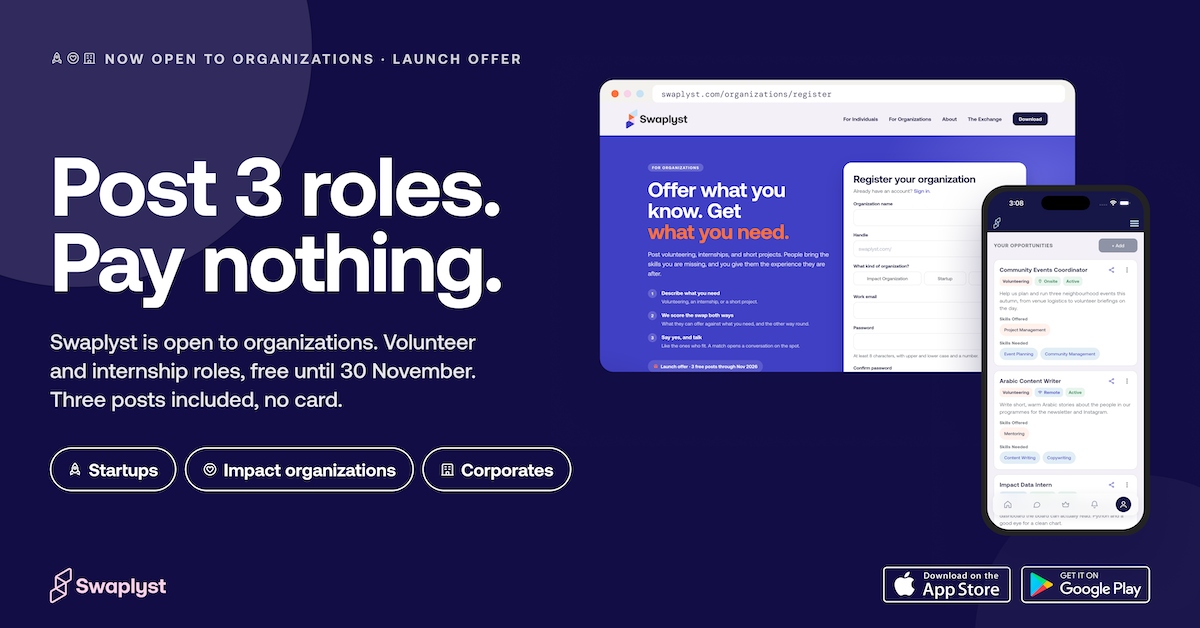
From today, NGOs, community initiatives, startups and corporates can register on the Swaplyst website or through the app and post opportunities for volunteers and interns. The opportunities are matched directly to individuals on the Swaplyst app, where they already sit alongside the peer-to-peer skill swaps the platform started with.
Registration is free and requires no card. Every organization that registers gets a free trial through the end of November 2026, which includes three posted opportunities. Any opportunity posted during the trial is promoted by Swaplyst on LinkedIn, Meta and by email to our users, at no cost to the organization. After the trial, posting will be a paid service; the trial is there so an organization can post, see who the matching brings them and judge the fit for themselves before that conversation happens.
Accelerators and startup programs can bring Swaplyst to the startups in their portfolios as a resource for finding volunteers and interns.
Nobody applies
The design decision that shapes everything else is that nobody applies on Swaplyst.
An organization tells us what the opportunity needs and what it offers in return. An individual tells us what they offer and what they want to gain. The matching works from both sides of that. It is AI-driven and it reads skills by meaning rather than by keyword, so a person who wrote "community management" is not invisible to an organization that wrote "volunteer coordination". Every match is scored in both directions, once for how well the person fits the opportunity and once for how well the opportunity fits the person.
Then comes the part I care about most. A connection opens only when both sides choose Swap. The organization sees a vetted fit and says Swap or No Swap. The individual sees the opportunity and does the same. A conversation starts only when both have said yes.
That one rule changes what an organization receives. Not a pile of applications nobody reads, but a short list of people who already want the role. It also changes what the individual experiences. Not forty submissions and silence, but a handful of opportunities that already want what they bring.
It is a different starting point from a career portal, where a candidate is matched against a single description and anyone can apply. We did not set out to build a better inbox. We set out to remove the inbox.
The exchange works both ways
Swaplyst is a skill exchange; that word is not decoration. No money changes hands anywhere on the platform. When an organization brings on a volunteer or an intern, it is receiving something real: time, skills, energy. So it offers something real back. Skills of its own, training, experience an individual could not buy or would not find behind a job title.
When an organization registers, we ask what it offers in return. Some find the question unusual at first. Most, once they think about it, realize they have plenty. A small NGO might offer grant-writing experience, a startup might offer a front-row seat to a product launch, a corporate team might offer a skill that sits behind a certification. The exchange is the point. Both sides walk away with more than they brought.
This is what Nakhwah asked of volunteers, turned around and asked of organizations too. Nakhwah asked people to give their time. Swaplyst asks organizations to give something back for it.
Where it lives
Organizations work from the organization portal on the Swaplyst website or from the app, whichever suits how they work. Individuals see everything in the app, matched to their profile, next to the swaps they already have going with peers.
The three ways to exchange on Swaplyst are now all live: volunteering with an organization, interning with a startup and swapping skills with a peer. They are one platform, one profile, one Swap or No Swap moment, because the person who volunteers with a community initiative this month is the same person who might offer a peer an hour of design feedback next month. We built it so that they never have to be two different people in two different places.
What comes next
Over the coming weeks I will be writing here about the organizations coming onto the platform and what the matching brings them. Some of that will be numbers. Most of it will be people, because that is the metric I have always come back to: how many people showed up for each other because a platform made it easy to.
If you run an organization and want to see who the matching finds for you, registration is open at swaplyst.com/organizations/register. The trial runs through the end of November.
Got skills? Swap them.
We all have something to offer.